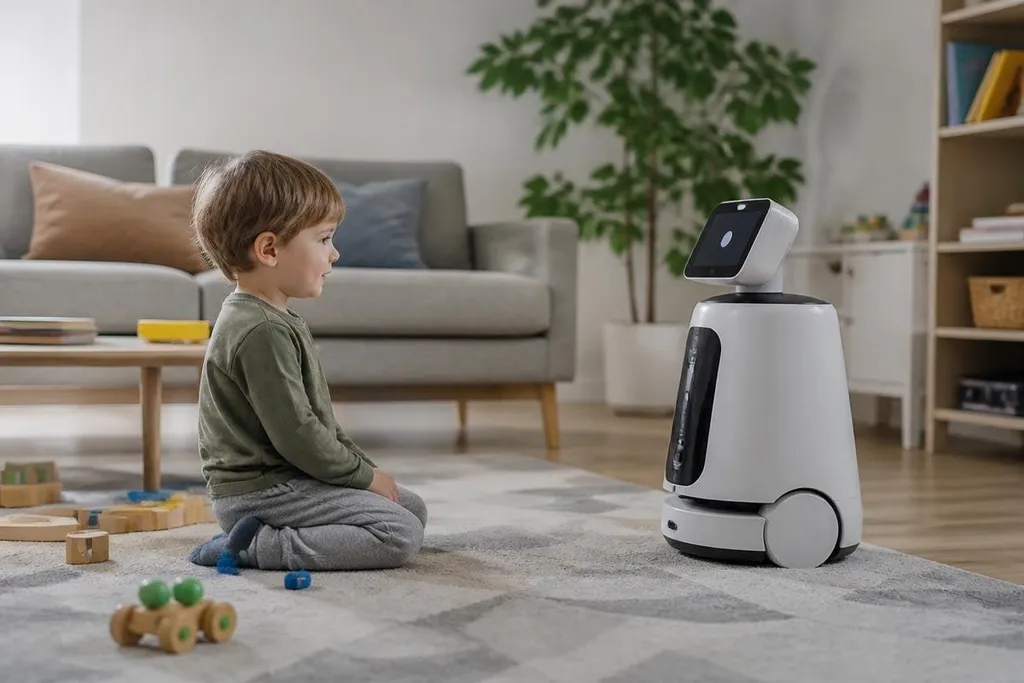
A robot that watches a child would carry more risk than a robot that vacuums a floor. It would need to understand a changing home, react to danger, and make its limits clear before families could rely on it.
- A camera can spot movement, but it can't replace adult judgment.
- The hardest test is an emergency, not a tidy product demo.
- Parents would need clear rules for data, alerts, and human control.
What a childcare robot could do
The useful work would sit around routine tasks. A robot could remind a child to wash their hands, read a story from a screen, carry a small item, or alert an adult when a child leaves a set area.
Those jobs sound modest. That may be the right place to start. A system that handles reminders and alerts has a smaller duty than one that claims to supervise a child alone.
A home robot would also need sensors for rooms, doors, sound, and movement. Its software would turn those signals into an alert, but the alert still needs a person on the other end. A parent may be at work, in another room, or asleep, so the system would need to show what it detected and why it sent the message.
This is where teleoperation could matter. Teleoperation means a person can take control from another location. For childcare, that feature would matter more than a polished voice or a human-shaped body.
The hard part is trust
Children do not act like fixed test targets. They run, hide, cry, change plans, and respond to the robot itself. A system trained on calm rooms may behave poorly when several things happen at once.
The robot would need to separate a harmless event from a dangerous one. A loud crash, a child lying on the floor, and a closed door could each mean several things. The system must ask for adult help when it cannot tell the difference.
A home also contains private material. Cameras and microphones could record family conversations, faces, and daily routines. Any product in this space would need plain settings for storage, deletion, access, and sharing. Families should know where data goes before the robot enters a child’s bedroom.
The next check is practical: can a childcare robot detect danger and keep private data under control? Reporting on childcare robots from Robot24.com can place those claims beside the test setup and human supervision, with data rules tied to the same report. That record leads into the limits these systems still need to prove.
What remains unproven
The phrase “childcare robot” covers very different machines. A mobile camera that sends alerts is one thing. A robot that lifts a child, prepares food, or moves through stairs is another.
The physical tasks bring their own limits. A robot may need to avoid fingers, toys, pets, cables, and wet floors without blocking a child’s path. Its battery may run low during the very period when a parent expects an alert. A network outage could remove remote control at the wrong moment.
No named product, price, trial, or safety record is supplied here. That leaves the central claim open: there is no basis for saying a childcare robot can safely replace a parent, guardian, or trained carer.
I’d keep childcare robots in the role of assistants until independent tests show how they behave around real children and real homes.
A practical buying checklist
Before bringing any childcare robot into a home, check these points:
- Define the task: Choose reminders, room alerts, or video calls instead of broad supervision claims.
- Test adult control: Confirm that a person can stop the robot and take control without relying on the robot’s own decisions.
- Check the alert: Find out what the system sends, how fast it sends it, and what happens when the network fails.
- Read the data rules: Confirm where recordings sit, who can view them, and how a family deletes them.
- Set room limits: Keep the robot away from stairs, cooking areas, baths, and any place where a fault could cause harm.
These checks turn a vague promise into a task a family can judge. They also show why a cute voice is a poor measure of childcare skill.
The first childcare robot worth considering will be the one that states its limits, hands control to an adult, and passes tests that families can see.